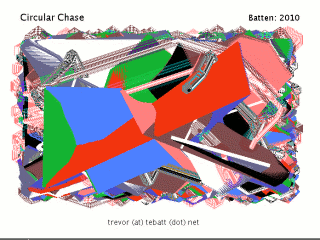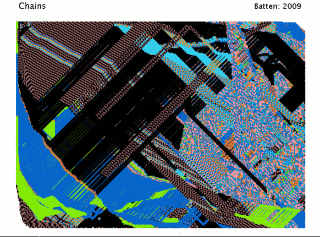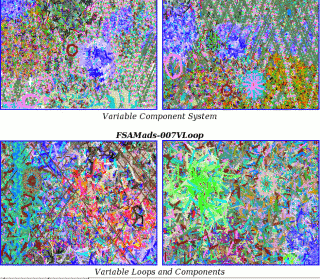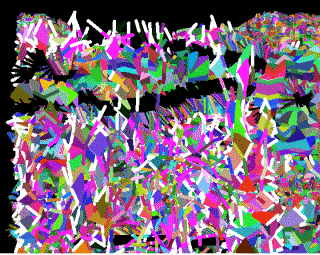
The Works (with notes):
General Remarks:
Please note that these are all Works In Progress -and liable to further modification -which shouldn't prevent anybody from remarking on any bugs or other problems, etc.... if they so wish..... :)
The first two works can be modified via the menu -by giving a right-mouse click (although the "Weaver" menu seems a little lazy on my machine -sometimes clicking on apparently empty space (where the menu should be) will "wake up" the component! :))). Hopefully, better programming technique will soon improve performance.
The third work doesn't currently have a menu.
All these works fall into the category of "slow computing" -and are considered to be a form of "visual wallpaper" with an infinite duration. Despite the presence (in some cases) of a menu -these are not "interactive" works. The menu is primarily intended to "configure" a work -after which the process is supposed to be completely autonomous.
I'm still hoping, some time in the (near) future to add sound to the works.....
For those who have problems with their browsers not running the applets: I have been told that Netscape 7.1 works fine. However, one will (also) need an active java plug-in Version 1.4.1 or higher.
The Creative Context:
These works are possibly conceptually much more complex than the visual complexity might suggest.
They are operating as practical experiments on a variety of levels. One of these levels is the nature of the process of developing language in general -including the process of programming a computer through some form of linguistic system. In this context, it is significant to note that I refer to a linguistic process and not simply to a process of "coding". I do not believe the two concepts should be confused. A "code" implies a reversible process between coding and decoding -and I do not believe that "language" allows itself to be "decoded" -simply because that which is expressed by language is also "created" by the language itself -and so cannot be "decoded" to an "original" form -as if it was external to language.
So one (another?) of the phenomena explored by these works (although probably invisible to the viewer) is the relationship between "form" and "content". Within my conceptual world this relates to the relationship between "epistemology" and "ontology" -in this context, the way the programme is written and the way it behaves (or is experienced by the observer). Presumably, the programme and the interpretation of the programme by the computer represent a mapping between epistemology and ontology.
Despite possible appearances, these works are (after a random initialization) completely deterministic. The data used to control the processes involved are all generated by the processes themselves -so the works also explore the long term behaviour of "chaotic" (but NOT random!) systems -based on intensive and continuous feedback. Despite what the dictionary says about "determinism" -chaotic systems are deterministic but not completely predictable.
The works described here also involve the interaction of different representations of the data present -so they can also be seen as models for "ecological" systems and perhaps even as social models.
The mapping of "information/data" into different contexts -and the retrieval of data from these contexts is also an important underlying theme -as are related concepts regarding the nature (and potential role) of conceptual space in the creative process -and fundamental concepts regarding the nature of computation.
Basically, the works are seen as "Goedelian interpretations of Einstinian Time/Space machines. In this context, a Turing machine is seen as a one-dimensional Time/Space machine.
These themes are explored further in the texts and on the original site.
Although these works are generally "concept driven" -they are also subject to ad hoc improvisation during development (the prerogative of the artist/programmer). The development cycle basically involves repeatedly modifying previous "prototypes" -so they are perhaps a bizarre (and personal) mixture of logic and intuitive improvisation.
Hopefully, the works also have some aesthetic value......
Some Notes on Space4D:
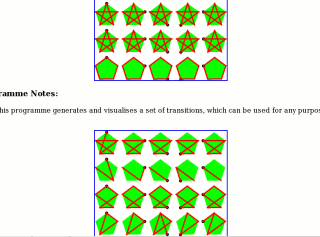
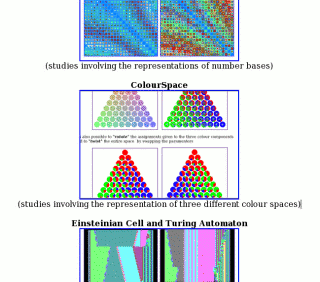
This is an experimental Java Work which constructs 16 four bit binary patterns in terms of a Four Dimensional Space.
The Space can be "folded" by clicking on the permutation patterns. The binary patterns are also represented in different ways. By clicking on the main pattern it is possible to change its representation. It is also possible to select the number base used to represent the number generated by each binary pattern.
Some Notes on Einstein/Turing:
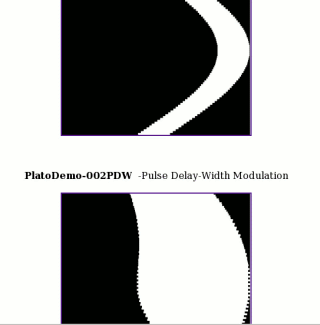
This is an experimental Java Programme which explores the basic underlying relationships between a Turing machine, a cell automat and an Einsteinian Time/Space machine.
The menu allows various options, operating in 1-D or 2-D Space, to be chosen.
Some Notes on VarLinS:
This work, is a "parametrification" of NomadS (formerly Meta-Weaver).
Instead of being a compendium of separate works -the underlying principles have been categorized -and ordered -allowing them to be placed under individual (more detailed) control -having been integrated into a single " conceptual space " -with the menu reflecting the underlying parameters relating to the conceptual analysis which is used to categorize and define the space involved. A space which both contextualizes and creates the (new) work..
The "Box" feature in NomadS has become a "meta-space" which makes the "image area" variable. ("line" has been dropped -because it seemed to have no relevant equivalent in the new system). The "Fig" features have also been removed (for development separately -as these are more complex variations of the simple basic principles (of moving and plotting a variable object). In this case, the "object" can be constructed from (two or more) line segments, the manner of connection of which can be, to a certain extent, determined by the control system.
Original Notes on LinSys:
This work is basically a Parametrification of MetaWeaver : The individual processes in the "compendium" having been integrated into a single " conceptual space " -with the menu reflecting the underlying parameters relating to the conceptual analysis which is used to categorize and define the space -which both contextualizes and creates the (new) work.
Because other distractions (and severe attention deficit disorder in the artist) have prevented "completion" of the work -some combinations of potential configurations work less effectively than others. The construction of a "grammatical" system which eliminated "bad" combinations would presumably save frustration by the user -but would also mask the significance of the problem.
Some Notes on NomadS:
This work, formerly called "meta-Weaver" and now re-named "NomadS" was the second work to be completed after "Quad".
It is a compendium of machines (from which an ecology can be built by selecting a small selection of different, or similar, processes). Each of these machines move around independently of the others -although they do "communicate" by modifying the (coloured) "environment" in which they live (and which also determines their behaviour).
The collection is more or less arbitrary and exploratory in nature. It is based a series of previous explorations -some (applications) in Java and some much earlier in Basic on the Amiga. They are all part of a learning process.... an attempt to develop a (possibly self-generating) system by exploring (and charting) the differences and similarities of various processes -so that they may be integrated and articulated on a "higher" (meta) level.
For some (now unknown) reason it was originally placed (under the title "MetaWeaver") on the "Work" page of my site in a way that suggests that it (in some way) "followed" Weaver -although now, by looking at the component classes, it is apparent that (the previous final version) of "Weaver" was developed after "meta-Weaver" (which is why I have decided to change the title -as part of a "renovation" process necessary because the interface did not function properly with more recent java versions).
The Original Notes (on MetaWeaver) said:
Some Notes on MetaWeaver:
Java has two basic forms:"applet"-which work in browsers and "application" -which work as normal programmes outside a browser. For some, still unknown, reason -the first Java programmes developed by the artist were applications and not applets.
MetaWeaver is basically a "compendium" work -initially integrating various previous experimental applications into a single work. However, in order to do this in an efficient manner, it was necessary to analyze the basic components of the different works in order to establish the basic principles involved -and the individual variations which were specific to each (previously) individual work. This process is still continuing -for example the "radial" lines used in some of the images are treated separately (at the moment) to the polygon shapes which are also used by some images -although there is perhaps no good reason to do so -as the polygons used are radial figures.
Later, it is hoped to integrate these (and perhaps other) different sets of procedural classes -for example, by redefining the radial lines as part of a polygon figure. At present it is impossible to tell how much changing the underlying conceptual structure will also modify the visible image (if at all).
It might also be worth noting that while Weaver is based on an organized scanning system, MetaWeaver contains both relatively structured and relatively unstructured (anarchistic) processes.
Some Notes on Weaver:
Object Orientated Programming Languages, such as Java, allow the programmer to develop a hierarchy of conceptual objects -such that "higher" concepts can "inherit" concepts, proceduresclasses" defined on a lower level.and "
A basic concept, underlying all the works listed on this page, is the idea of "Multi-Dimensional Conceptual Spaces" which are considered (by the artist) to be arbitrary conceptual constructions composed of combinations of various (conceptual -or conceptualized physical) parameters, coordinates or "dimensions".
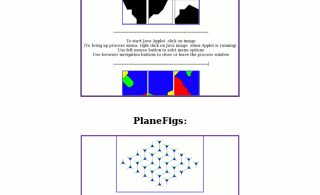
Weaver is a simple exploration of this concept. A number of parallel 2-Dimensional spaces are continually "scanned". At each position, it is possible (under menu control) to "read" colour values at the scanning point -or its equivalent in a neighborouring scan. This point is compared with a number of other points (surrounding the scanning point -or its equivalent in a neighborouring scan) and a new colour value is derived from the result. The increment, and the size of the space scanned can be varied (under menu control) -so that essentially, information produced by one scanning process can be written by another (mapping between different spaces -possibly of different size) -or maybe the origianal point is simply "re-written" in a new colour (depending on the choices made). The graphic "glyph" used to "write" the colour information to the screen can also be determined via the control system.
Basically, the system explores the interactions between the various cycles scanning through the image space.
Some Notes on Quad:
Comparing Weaver with MetaWeaver might reveal a tension between works which are conceptually interesting and works which are visually interesting.
Hopefully, Quad is somewhere in the middle of this aesthetic dichotomy..
As an exception, this work is not based on the practical implementation of the basic parametrical space system, which (on various levels) is fundamental to the other works (although this principle is still operative on a conceptual level).
On one level, the work is based on a visual interpretation/implementation of a voltage controlled oscillator -a fundamental piece of equipment found in the analogue studio at the Institute for Sonology (then in Utrecht), where the artist studied when a young man.
Basically, a VCO produces a sine-wave -which varies in frequency according to the voltage level fed into it. however, the basic amplitude oscillates (in the theoretical model) between +1 and -1 which allows it to be easily mapped into a dimension of any size (as happens when one draws a circle -where the basic sine/cosine functions are mapped to a specific radius).
Any changing variable has a minimum and a maximum value -so one can easily link three oscillators together in a single group -such that each oscillator has its minimum and maximum values determined by the other two.
A rectangle can be constructed from any two points -each with an x and a y coordinate -thus a total of 4 parameters is required. So it requires a bit of 'fiddling" to create a group of oscillators which control the movements of the two points that define a rectangle (this is something that requires further working out within the context of the applet). However, once this is established (more or less) -one can use the colour value found at the location of the point to control the relevant group of oscillators (if one interprets the colour in terms of red, green, blue components this maps easily to three oscillators -but one could include the transparency -in which case one would have four control parameters available).
Once a rectangle has been defined -it can be redefined as a diamond shape -by bisecting the sides and connecting the points......
......Or one can interpret the original four parameters (which determine the locations of the corners of the rectangle) in completely different ways -as defining the radius, rotation and central x,y position of a variable square, for example -or even as determining the radius, rotation and location of two connected lines.
Later, when sound is added, it will be interesting to see how the oscillator system used for the sound will relate to the one used for the image.